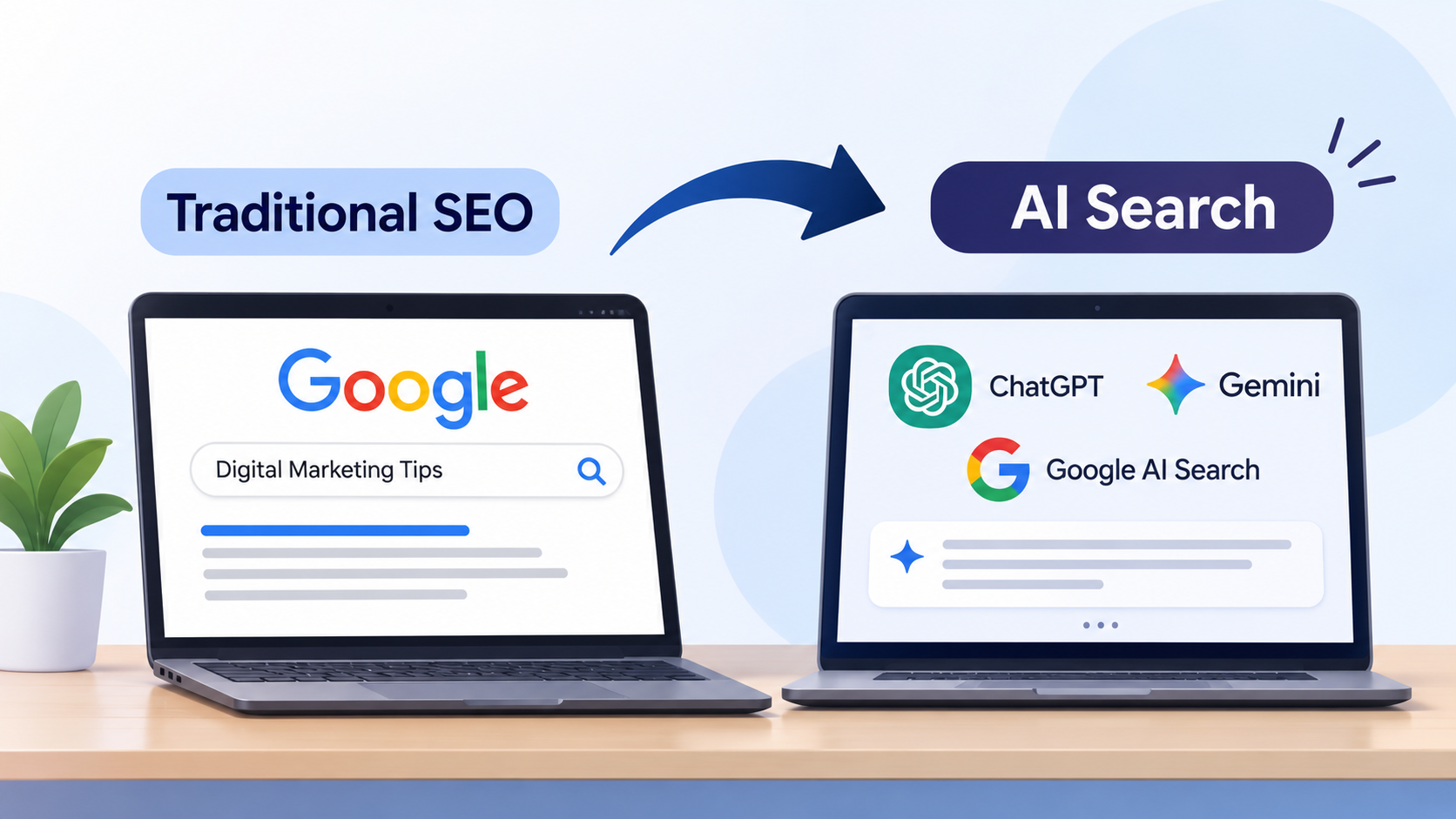
Search engines are changing. Earlier, people searched for information on Google, clicked on websites, compared different options, and made decisions.
Today, the way people discover information is evolving.
People are increasingly asking questions directly to AI platforms such as ChatGPT, Google Gemini, and Perplexity. Instead of browsing multiple websites, they can receive conversational answers, recommendations, comparisons, and summaries.
This shift is creating a new opportunity for businesses and digital marketers: AI Search Optimisation.
But what does this mean for traditional SEO? How can businesses improve their visibility in AI-powered search experiences? And what skills will digital marketers need in 2027?
Let's explore.
1. What Is AI Search Optimisation?
AI Search Optimisation is the process of making your website, brand, products, and content easier for AI-powered search experiences to discover, understand, and potentially reference in their responses.
Traditional SEO primarily focuses on improving a website's visibility in search engine results pages.
AI search introduces another discovery experience where users ask conversational questions such as:
Which is the best digital marketing institute in Bangalore?
What are the best digital marketing courses for freshers?
Recommend a digital marketing agency for a small business.
How can I improve my website's Google ranking?
Which digital marketing tools should beginners learn?
AI platforms may generate answers using information from multiple sources and provide links to relevant websites.
This means businesses should think beyond traditional keyword rankings and focus on building useful, trustworthy, and easily discoverable online content.
2. Traditional SEO vs AI Search Optimisation
Both approaches are important, but they focus on different discovery experiences.
Traditional SEO
AI Search
Focuses on search engine rankings
Focuses on AI-powered discovery
Targets keywords and search intent
Understands conversational questions
Aims to attract organic clicks
Can influence recommendations and citations
Uses website optimisation and backlinks
Benefits from useful, credible, discoverable information
Measures rankings, clicks and traffic
Also considers brand visibility and AI referrals
One important point: AI search does not replace traditional SEO. Google confirms that its established SEO fundamentals remain relevant to AI Overviews and AI Mode.
Businesses should build a strategy that supports both experiences.
3. How to Optimise Your Website for AI Search
Here are eight practical strategies businesses can start implementing.
1. Create Content That Answers Real Questions
AI-powered search experiences are designed to understand what users are asking.
Instead of publishing articles that simply repeat keywords, create content that answers specific questions.
For example, instead of writing:
"Digital Marketing Services"
Create useful articles such as:
How much does digital marketing cost for a small business?
How can a local business generate leads through Google Ads?
How does SEO help businesses get customers?
Which digital marketing strategy works for startups?
Provide clear explanations, examples, comparisons, and actionable recommendations.
The goal is to become a useful information source rather than simply publishing content to target keywords.
2. Build Topic Authority
Publishing one article about a subject is not enough to establish expertise.
Create a collection of related articles that cover different aspects of your industry.
For example, a digital marketing agency could build content around:
Search Engine Optimisation
Local SEO
Google Ads
Meta Ads
Content Marketing
Social Media Marketing
Marketing Automation
AI Marketing
Link related articles together so visitors can explore the subject in more detail.
This helps create a well-organised website with useful information for both visitors and search engines.
3. Build Your Brand Presence Across the Internet
Your website should not be the only place where people discover your business.
Develop a consistent presence across relevant platforms:
LinkedIn
YouTube
Instagram
Industry publications
Relevant business directories
Professional communities
Trusted review platforms
Publish useful information, participate in industry discussions, share original insights, and maintain accurate business information.
Focus on genuine brand recognition and credibility rather than buying artificial mentions or spam backlinks.
4. Publish Original Research and Practical Case Studies
One of the strongest ways to make your content valuable is to share information that others cannot easily reproduce.
Consider publishing:
Real marketing campaign case studies
Before-and-after website improvements
Industry surveys
Marketing performance reports
Practical project demonstrations
Expert interviews
Original research and observations
For example, instead of publishing another generic article about Google Ads, explain how a particular campaign was planned, what audience was targeted, what was tested, and what the results showed.
Always use genuine data and clearly explain the context.
Original experience makes content more useful and gives readers a reason to trust your website.
5. Optimise Your Website's Technical SEO
AI visibility still depends heavily on discoverability and accessible website content.
Make sure your website has:
Proper indexing and crawling.
An XML sitemap.
Clear website navigation.
Mobile-friendly design.
Fast-loading pages.
Descriptive page titles and meta descriptions.
Logical heading structures.
Relevant internal links.
Accurate structured data where appropriate.
Make important information available as readable text rather than relying entirely on images or inaccessible interactive elements.
Also check Google Search Console regularly to identify indexing and technical issues.
6. Use Conversational Keywords and Question-Based Content
People often interact with AI platforms using natural language.
For example:
Traditional search: "Digital marketing course Bangalore"
Conversational search: "Which digital marketing course should I choose if I am a fresher with no experience?"
Create content that addresses the real questions behind these searches.
Useful formats include:
Frequently asked questions.
Step-by-step guides.
Comparisons.
Detailed tutorials.
Beginner-friendly explanations.
Industry-specific recommendations.
Do not create hundreds of repetitive pages just to cover different keyword variations. Focus on answering questions properly.
7. Improve Your Business Information and Online Reputation
Businesses should maintain accurate information across their website and relevant online platforms.
Important details include:
Business name and contact information.
Services and specialisations.
Location and service areas.
Working hours.
Customer reviews.
Portfolio and case studies.
Frequently asked questions.
Encourage genuine customer reviews and respond professionally to feedback.
A consistent and trustworthy brand presence makes it easier for potential customers to understand your business.
8. Measure AI Search Visibility
Traditional SEO metrics such as impressions, clicks, rankings, and organic traffic remain important.
You can also monitor:
Traffic referred from AI platforms.
Brand mentions in AI-generated responses.
Referral conversions.
Enquiries from organic visitors.
Growth in branded searches.
Engagement with educational content.
Use Google Search Console and Google Analytics to understand how visitors discover and interact with your website.
Remember that AI platforms do not all provide the same visibility or reporting capabilities, so measurement will require a combination of available analytics and manual checks.
4. Do You Need a Separate GEO Strategy?
You may have heard the term Generative Engine Optimisation (GEO).
GEO generally refers to strategies aimed at improving the visibility of brands and content in generative AI experiences.
It is an emerging area of digital marketing.
However, businesses should be careful about agencies or tools promising guaranteed ChatGPT rankings, guaranteed AI citations, or instant AI visibility.
There is no universal technique that guarantees your business will appear in every AI-generated answer.
Google's official guidance also makes an important point: you do not need special AI files such as llms.txt or special schema markup to appear in Google's AI search features.
Strong SEO foundations, useful content, technical accessibility, and genuine expertise remain essential.
5. What Skills Will Digital Marketers Need in 2027?
The changing search landscape creates new opportunities for digital marketing professionals.
Future marketers should understand both traditional marketing and emerging AI technologies.
Here are some important skills to develop:
SEO & AI Search Optimisation
Understand search intent, technical SEO, content strategy, local SEO, and AI-powered discovery.
Content Strategy
Learn how to research topics, develop useful content, build authority, and communicate expertise.
AI Tools
Understand how to use AI for research, content development, marketing analysis, and productivity.
Performance Marketing
Develop skills in Google Ads, Meta Ads, campaign optimisation, and conversion tracking.
Marketing Analytics
Learn to analyse traffic, user behaviour, campaign performance, and business outcomes.
Marketing Automation
Understand how to automate repetitive marketing activities, lead nurturing, and customer communication.
The future of digital marketing will require professionals who can combine creativity, strategy, technology, and analytical thinking.
6. A Practical 30-Day AI Search Optimisation Plan
If you own a business or work in digital marketing, here is a simple starting plan.
Week 1: Website Audit
Check website indexing.
Review technical SEO.
Identify important service pages.
Research customer questions.
Week 2: Content Development
Publish two useful, in-depth articles.
Add FAQs to relevant service pages.
Improve existing website content.
Add relevant internal links.
Week 3: Brand Authority
Publish useful LinkedIn content.
Share educational YouTube videos.
Update business profiles.
Collect genuine customer feedback.
Week 4: Performance Review
Review Google Search Console.
Analyse organic traffic.
Check website engagement.
Monitor AI referral traffic where available.
Identify opportunities for improvement.
Continue reviewing and improving your strategy every month.
Conclusion: The Future of Search Is Evolving. Are You Ready?
Digital marketing is entering a new phase.
Traditional search engines, AI-powered search experiences, conversational platforms, and intelligent assistants are changing how people discover information and businesses.
For companies, this creates new opportunities to build visibility, trust, and customer relationships.
For digital marketing professionals, it creates opportunities to develop new skills and work with emerging technologies.
The important thing is not to abandon traditional SEO or blindly follow every new AI trend.
Instead, build a strong foundation, create genuinely useful content, develop your brand authority, and understand how people discover information across different platforms.
The future belongs to marketers who know how to combine SEO, AI, content, creativity, and practical experience.
At Digital Academy Lab, we believe the best way to prepare for this changing industry is through continuous learning and practical application.
Learn. Practise. Grow.
Frequently Asked Questions (FAQs)
1. What is AI Search Optimisation?
AI Search Optimisation is the process of improving your website and brand's discoverability in AI-powered search experiences such as ChatGPT, Gemini, and Google AI Search.
2. Is traditional SEO still important in 2027?
Yes. Traditional SEO remains an important foundation for website discovery. Technical SEO, helpful content, indexing, and website quality continue to matter.
3. What is Generative Engine Optimisation (GEO)?
GEO refers to strategies that aim to improve a brand's visibility and presence in AI-generated answers and recommendations.
4. Can ChatGPT recommend my business?
AI platforms may reference or recommend businesses based on the information available to them and the context of a user's question. However, no business can guarantee inclusion in every AI-generated response.
5. Which skills should I learn for AI-driven digital marketing?
SEO, AI tools, content strategy, performance marketing, analytics, and marketing automation are valuable skills for modern digital marketers.
6. How long does AI Search Optimisation take to show results?
There is no fixed timeline. Results depend on website quality, content relevance, technical accessibility, competition, and how different AI platforms discover and use information.
Home/Blog/AI Search vs Traditional SEO: How to Get Your Business Featured in ChatGPT, Gemini & Google AI Search in 2027
DigitalAcademyLab guide
AI Search vs Traditional SEO: How to Get Your Business Featured in ChatGPT, Gemini & Google AI Search in 2027
Learn how to optimise your website for ChatGPT, Gemini and Google AI Search. Explore GEO, SEO strategies, practical tips and future digital marketing skills.